1.3 Social and Emotional Learning: Basic Choices
3. A Guiding Model
 Social and emotional development is a lifelong process, and its
success is revealed by the expression of social and emotional competencies.
This competence could be conceptualized as the ability to understand, manage,
and express the social and emotional aspects of one’s life in ways that enable
the successful management of life tasks such as learning, forming
relationships, solving everyday problems, and adapting to the complex demands
of growth and development (LaBar & Cabeza, 2006).
Social and emotional development is a lifelong process, and its
success is revealed by the expression of social and emotional competencies.
This competence could be conceptualized as the ability to understand, manage,
and express the social and emotional aspects of one’s life in ways that enable
the successful management of life tasks such as learning, forming
relationships, solving everyday problems, and adapting to the complex demands
of growth and development (LaBar & Cabeza, 2006).
The effort carried out in the United States by the Collaborative for Academic, Social, and Emotional Learning (CASEL), in the last twenty years has spread research on socioemotional learning (SEL) defined as a process through which children and adults effectively acquire and apply the knowledge, attitudes and skills necessary to understand and manage emotions, to establish and achieve goals, to try and show empathy for others, to establish and maintain relationships positive, and to take decisions responsibly (Schonert-Reichl, 2017). More specifically, there are five skills that are expected to become an essential - and not ancillary - part of the school curriculum, starting from early ages, to ensure a positive growth of the new generations.
The provision proposed by CASEL is widely followed:
o Self-Awareness (Identifying and recognizing emotions; Accurate self-perception; Recognizing strengths, needs, and values; Self-efficacy; Spirituality);
o Social Awareness (Perspective taking; Empathy; Appreciating diversity; Respect for others);
o Responsible Decision Making (Problem identification and situation analysis; Problem solving; Evaluation and reflection; Personal, moral, and ethical responsibility);
o Self-Management (Impulse control and stress management; Self-motivation and discipline; Goal setting and organizational skills);
o Relationship Management (Communication, social engagement, and building relationships; Working cooperatively; Negotiation, refusal, and conflict management; Help seeking and providing).
o perform tasks that require subject knowledge, but successful completion of the task requires the demonstration of social and emotional competencies.
o A positive school climate that allows the student to feel a constant care for his or her well-being. In the atmosphere of care and consideration students are motivated to transfer the knowledge gained in the classroom environment and apply it in a variety of activities and settings. Without feeling stressed and emotionally vulnerable, students feel free to demonstrate social and emotional competencies. Only by feeling safe students transfer the social and emotional competencies acquired during lessons outside the classroom and develop appropriate behavioral skills.
o School - community collaboration. The level of engagement in local community, the leaders of the community, determines whether the student will apply social and emotional competencies after school. Social and emotional learning outside school takes place only when the school, families and informal community leaders are united by the same philosophy of the importance of social and emotional learning.
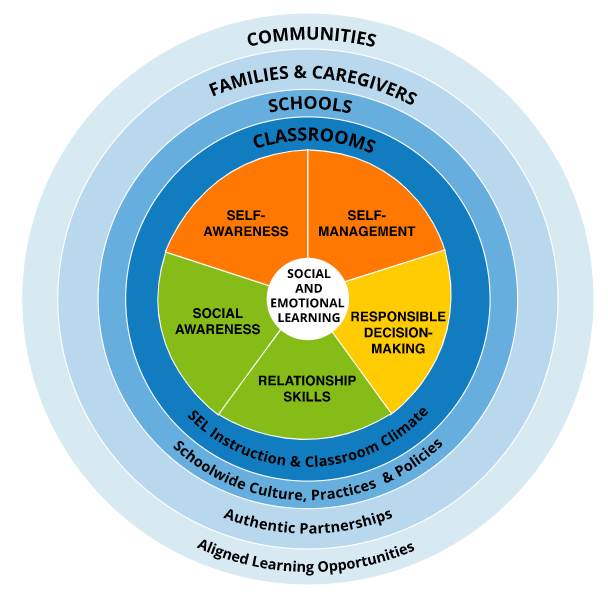
Figure 1. CASEL framework (Casel.org)
The CASEL framework promotes a series of skills that allow the development of resources and strengths while preventing counterproductive behavior and unsatisfactory results (Damon, Lerner, Renninger, Sigel, 2006).