1.3 Social and Emotional Learning: Basic Choices
| Site: | PSsmile E-learning Course |
| Course: | Part 1. Theoretical and Methodological Background |
| Book: | 1.3 Social and Emotional Learning: Basic Choices |
| Printed by: | Guest user |
| Date: | Tuesday, 25 August 2026, 8:06 AM |
1. Introduction
Social and emotional learning is the process through which we learn to recognize and manage emotions, care about others, make good decisions, behave ethically and responsibly, develop positive relationships, and avoid negative behaviors (Donoso, Collins, & Koechlin, 2014). It is the learning that unites all areas of human life: social, emotional, academic, cognitive, physical, etc. It begins in the first year of life and lasts a lifetime. School may play a specific role in its development.
2. The Roots
 For centuries, social and emotional learning has taken place in
small groups such as the family, the neighborhood, and the classes. In these
small groups, societies had the opportunity of transferring to children their
social norms and values, skills, and habits of prosocial behaviour with low
level of modification.
For centuries, social and emotional learning has taken place in
small groups such as the family, the neighborhood, and the classes. In these
small groups, societies had the opportunity of transferring to children their
social norms and values, skills, and habits of prosocial behaviour with low
level of modification.
The fast and often unpredictable changes and complexities of actual societies highly impacted the status quo. Traditional values and vision are challenges so much that in some cases the liquid modernity is depicted as a crisis of social principles, ethical values, moral directions (LaBar & Cabeza, 2006). Difficulties in adult life could negatively impact the construction of a trust and healthy relationship with children and reduce the opportunity of learning adequate social and emotional skills. Positive child development is, in fact, threatened by unsupportive and unmeaningful relationships with adults. In extreme cases they could experience so negative feelings and emotions that they could arrive to think to have nothing to lose and take dramatic decisions.
What is highlighted by international warning is that mental health problems are arising: anxiety, depression, propensity to use addictive substances, breaking the rules, or criminal behavior. Providing opportunities for social and emotional learning is targeted as a crucial for coping with a variety of life situations since the consequences of social and emotional incompetence limit the future lives of young people. Consequently, adults and educators need to become aware of the importance of social and emotional learning and make all the efforts for providing environments where children and adolescents can experience care and acquire social and emotional competencies.
The school is of course a prominent place where social and emotional learning can be carried out. Educators are requested to be aware of children challenges, understand how complex it is growing in actual societies and become a protective factor that outweighs all these risks.
3. A Guiding Model
 Social and emotional development is a lifelong process, and its
success is revealed by the expression of social and emotional competencies.
This competence could be conceptualized as the ability to understand, manage,
and express the social and emotional aspects of one’s life in ways that enable
the successful management of life tasks such as learning, forming
relationships, solving everyday problems, and adapting to the complex demands
of growth and development (LaBar & Cabeza, 2006).
Social and emotional development is a lifelong process, and its
success is revealed by the expression of social and emotional competencies.
This competence could be conceptualized as the ability to understand, manage,
and express the social and emotional aspects of one’s life in ways that enable
the successful management of life tasks such as learning, forming
relationships, solving everyday problems, and adapting to the complex demands
of growth and development (LaBar & Cabeza, 2006).
The effort carried out in the United States by the Collaborative for Academic, Social, and Emotional Learning (CASEL), in the last twenty years has spread research on socioemotional learning (SEL) defined as a process through which children and adults effectively acquire and apply the knowledge, attitudes and skills necessary to understand and manage emotions, to establish and achieve goals, to try and show empathy for others, to establish and maintain relationships positive, and to take decisions responsibly (Schonert-Reichl, 2017). More specifically, there are five skills that are expected to become an essential - and not ancillary - part of the school curriculum, starting from early ages, to ensure a positive growth of the new generations.
The provision proposed by CASEL is widely followed:
o Self-Awareness (Identifying and recognizing emotions; Accurate self-perception; Recognizing strengths, needs, and values; Self-efficacy; Spirituality);
o Social Awareness (Perspective taking; Empathy; Appreciating diversity; Respect for others);
o Responsible Decision Making (Problem identification and situation analysis; Problem solving; Evaluation and reflection; Personal, moral, and ethical responsibility);
o Self-Management (Impulse control and stress management; Self-motivation and discipline; Goal setting and organizational skills);
o Relationship Management (Communication, social engagement, and building relationships; Working cooperatively; Negotiation, refusal, and conflict management; Help seeking and providing).
o perform tasks that require subject knowledge, but successful completion of the task requires the demonstration of social and emotional competencies.
o A positive school climate that allows the student to feel a constant care for his or her well-being. In the atmosphere of care and consideration students are motivated to transfer the knowledge gained in the classroom environment and apply it in a variety of activities and settings. Without feeling stressed and emotionally vulnerable, students feel free to demonstrate social and emotional competencies. Only by feeling safe students transfer the social and emotional competencies acquired during lessons outside the classroom and develop appropriate behavioral skills.
o School - community collaboration. The level of engagement in local community, the leaders of the community, determines whether the student will apply social and emotional competencies after school. Social and emotional learning outside school takes place only when the school, families and informal community leaders are united by the same philosophy of the importance of social and emotional learning.
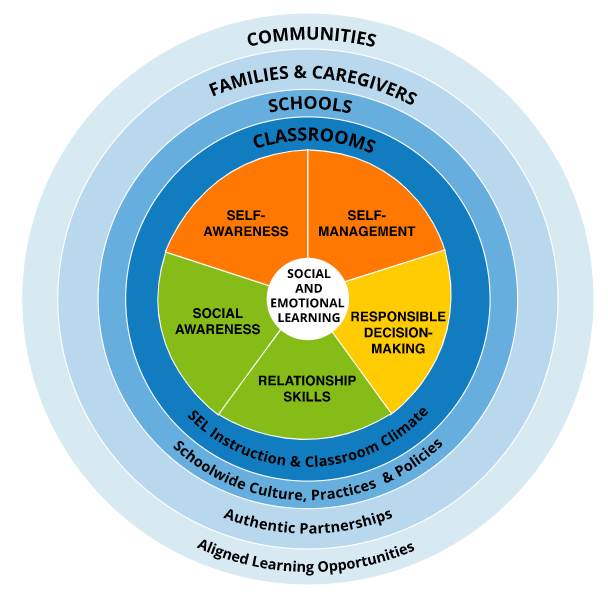
Figure 1. CASEL framework (Casel.org)
The CASEL framework promotes a series of skills that allow the development of resources and strengths while preventing counterproductive behavior and unsatisfactory results (Damon, Lerner, Renninger, Sigel, 2006).
4. Research Studies and Actions
 At the initiative of CASEL and other organizations, many social and
emotional education programs have been developed for schools. The impact of
these programs on student development and academic success has been analyzed
according to the most rigorous research methodologies. Decades of research have
revealed that effective social and emotional education programs cover three
areas:
At the initiative of CASEL and other organizations, many social and
emotional education programs have been developed for schools. The impact of
these programs on student development and academic success has been analyzed
according to the most rigorous research methodologies. Decades of research have
revealed that effective social and emotional education programs cover three
areas:

Using student-centered teaching methodology specific SEL methods are developed and used. Students are involved in activities where they practice engagement, communication, collaboration, etc. They demonstrate social and emotional competencies in a classroom setting. These methods can be presented in two ways. The first way is to dedicate a lesson to the topic of developing social and emotional competencies. Learning time is allocated on a regular basis each week, during which students deepen and practice social and emotional competencies in the classroom. The second way is to integrate the content of social and emotional education and the content of the subject. In this case, students perform tasks that require subject knowledge, but successful completion of the task requires the demonstration of social and emotional competencies.

It allows the student to feel a constant care for his or her well-being. In the atmosphere of care and consideration students are motivated to transfer the knowledge gained in the classroom environment and apply it in a variety of activities and settings. Without feeling stressed and emotionally vulnerable, students feel free to demonstrate social and emotional competencies. Only by feeling safe students transfer the social and emotional competencies acquired during lessons outside the classroom and develop appropriate behavioral skills.

The level of engagement in local community, the leaders of the community, determines whether the student will apply social and emotional competencies after school. Social and emotional learning outside school takes place only when the school, families and informal community leaders are united by the same philosophy of the importance of social and emotional learning.
Social and emotional learning for many students nowadays begins in the classroom and provides answers to many concerns. For children and adolescents, relationships are extremely important, so curricula focusing on how to build respectful and meaningful relationships are also very important. On the other hand, the end results of social and emotional learning are determined by the environment. Effective social and emotional learning occurs when the school and community environment supports and affirms the expression of the student’s social and emotional competencies.
5. Our Lenses
 Social and emotional education includes coordinated efforts to teach
children self-awareness, social cognition, the ability to make responsible
decisions, self-management, and relationship management skills. It is closely
related to the improvement of academic results and, together with the
teaching methodology and the quality of school management, is one of the three
key factors determining the success of a school.
Social and emotional education includes coordinated efforts to teach
children self-awareness, social cognition, the ability to make responsible
decisions, self-management, and relationship management skills. It is closely
related to the improvement of academic results and, together with the
teaching methodology and the quality of school management, is one of the three
key factors determining the success of a school.
Pillars in this process are then:
 Providing
opportunities for learning and fostering social and emotional skills
Providing
opportunities for learning and fostering social and emotional skills
It has multiple benefits for actual and future life of children and their life contexts. The dialogue between personal aspects with social aspects emerge as crucial in thinking about training program that aim to foster a positive development.
Becoming
more skilled in making good decision assumes a preventive
meaning
It shows its relevance both in personal and social dimensions of actual and future life. Children should in fact be offered opportunities for learning skills that allow them to process the present with a glance to the future in a co-construction effort that joint schools as well as families.