{mlang en}The PSsmile app: The adults’ learning point{mlang} {mlang it}insert text here{mlang} {mlang lt}insert text here{mlang} {mlang pt}insert text here{mlang} {mlang el}insert text here{mlang} {mlang bg}insert text here{mlang}
| Site: | PSsmile E-learning Course |
| Course: | Part 3. App and Additional Sources |
| Book: | {mlang en}The PSsmile app: The adults’ learning point{mlang} {mlang it}insert text here{mlang} {mlang lt}insert text here{mlang} {mlang pt}insert text here{mlang} {mlang el}insert text here{mlang} {mlang bg}insert text here{mlang} |
| Printed by: | Guest user |
| Date: | Tuesday, 25 August 2026, 8:10 AM |
1. Introduction
Without adequate training of the adults who have the greatest influence in the lives of children, i.e., parents and teachers, socio-emotional education loses its effectiveness. The increase in the socio-emotional skills of teachers not only favors their transmission to pupils but also improves teachers’ personal development, relationship skills, quality of life, and satisfaction, making the educational environment more serene (Elias et al., 2015, Weissberg et al., 2004, Zins et al., 2007).
As for the parents, evidence suggests that SEL practices support positive parental involvement in the lives of their children, improving the parent-child relationship (OECD, 2015, Elliot et al., 2021). Parents are the first socialization agency in children’s lives. By growing up in a family environment that supports them emotionally, children are more likely to develop positive relationships with teachers and peers, leading to better academic achievements, motivation, and improved social skills (Jennings et al., 2019, Sheridan et al., 2017). Additional benefits come from school-family partnerships, which promote children’s learning. (Sheridan et al., 2019).
Finally, parents who are proficient in socio-emotional skills may also help children negotiate the numerous challenges and inequalities they experience in school and in different social contexts, such as the socio-economic status, gender stereotypes, and ethnic prejudices, contributing greatly to their mental health and well-being (Lerner et al., 2011).
These benefits have not been ignored within the Erasmus+ project “Socio-emotional Capacity Building in Primary Education” (PSsmile). Indeed, the project activities were developed from the outset to maximize the involvement of children, teachers, and parents. As for the last two target groups, the project partnership has produced a specific Intellectual Output for the development of their socio-emotional skills: the PSsmile Mobile App. By raising adults’ SEL awareness and competencies, the PSsmile app contributes to building emotionally stable, inclusive, and healthy communities, that take care of their socio-emotional functioning and support its development in children.
In this chapter, we will show the reader the structure of the app, its functioning, and its effects. The goal is to contribute to the development of more inclusive and emotionally stable educational communities, inviting as many teachers and parents as possible to improve their socio-emotional skills by carrying out simple and short daily tasks. Aware of the fact that socio-emotional skills require constant commitment and that their development can only occur through lifelong learning, we hope that this app can help all its users to begin a journey of self-improvement, which will have significant positive repercussions on their lives, the lives of their children and the whole community.
2. The PSsmile app training and its content
The PSsmile Mobile App is an SEL guide structured to be a five-week-ling training program (Fig. 1). The training program follows the structure designed within the PSsmile project, which sees socio-emotional skills distributed between four domains (Self-awareness, Self-management, Social-awareness, and Social-management) and two overarching components (Decision making and Goal setting). Each week is dedicated to perfecting the skills of a specific domain, through the administration of daily exercises. In four weeks, learners develop skills related to the 4 domains of SEL, while in the fifth week they carry out exercises focused on improving their decision-making and planning skills. Users are asked to carry out their activities from Monday until Friday.
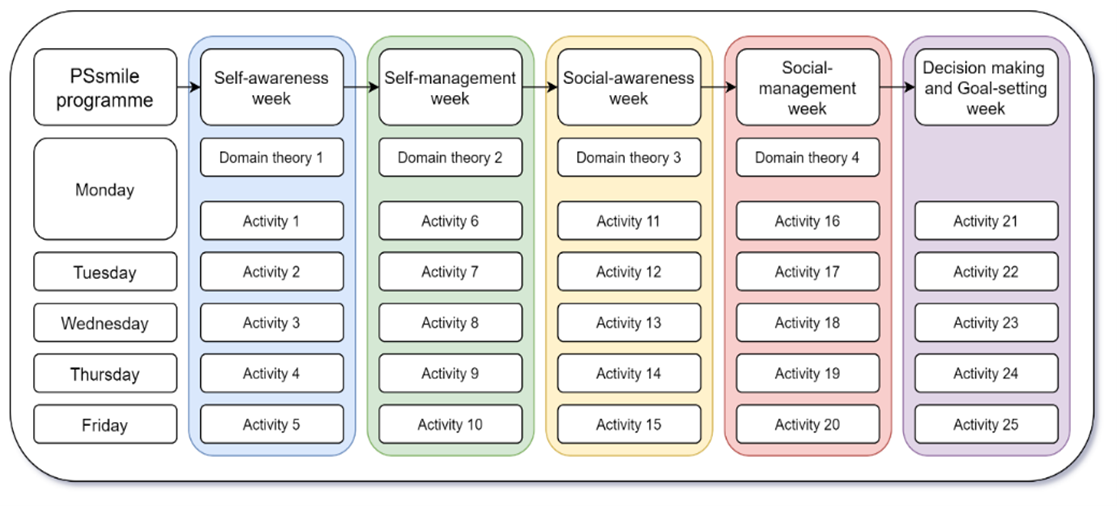
Fig. 1 PSsmile program structure
Not all the activities are immediately available to users, who are required to strictly follow the program structure. Once they start, every 24 hours the system unlocks the following activity. The program was designed in this way to promote incremental skills development and provide learners with enough time to reflect on what they have attained.
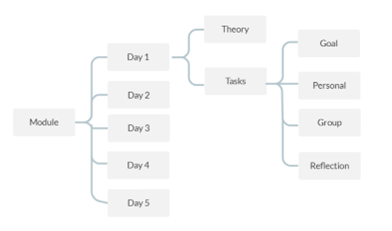
Each day is further divided into two sections: Theory and Tasks. The first provides an overview of the domain’s theme, illustrating the theoretical background of the activities and the skills that will be taught. The second section provides the activities of the day. The section “Tasks” is further divided into (Fig 2.):
Goal: the objective of the day’s topic and activities
Personal: an individual task assigned to the user
Group: a group activity that adults may carry out with pupils
Reflection: a self-assessment questionnaire, analyzing the successfulness of the activities and helping the learners reflect on them