Navigating The Curriculum And Tracking Learning
| Site: | PSsmile E-learning Course |
| Course: | Part 2. Curriculum Framework |
| Book: | Navigating The Curriculum And Tracking Learning |
| Printed by: | Guest user |
| Date: | Tuesday, 25 August 2026, 9:00 AM |
1. Navigating The Curriculum And Tracking Learning
Assessment of students’ achievement is an inseparable part of education that influences students’ motivation, confidence, further academic and career choices as well as well-being. To improve student achievement, which is an ultimate goal of educational systems, an integrated and dynamic assessment system should be applied. Both observation of students’ behaviour and their direct involvement reflecting upon school experience and other everyday life contexts.
With a similar importance, to make assessment of individual and class progress, we will involve teachers proposing them tools that address children learning and involve themselves as active participant in the assessment process.
Finally, parents will be also involved to promote the participation in the process and assess the quality of the learning experience from the significant caregivers’ perspective.
All tools are proposed to address the SE skills focus of the project, following the specific learning goals associated with the activities and project’s guiding principles, that is attention to both decision making and future and adoption of UDL principles.
1.1. The Learning Path
Several actions, actively involving the diverse agents of change with qualitative and quantitative measures, are proposed at different steps in the learning path.
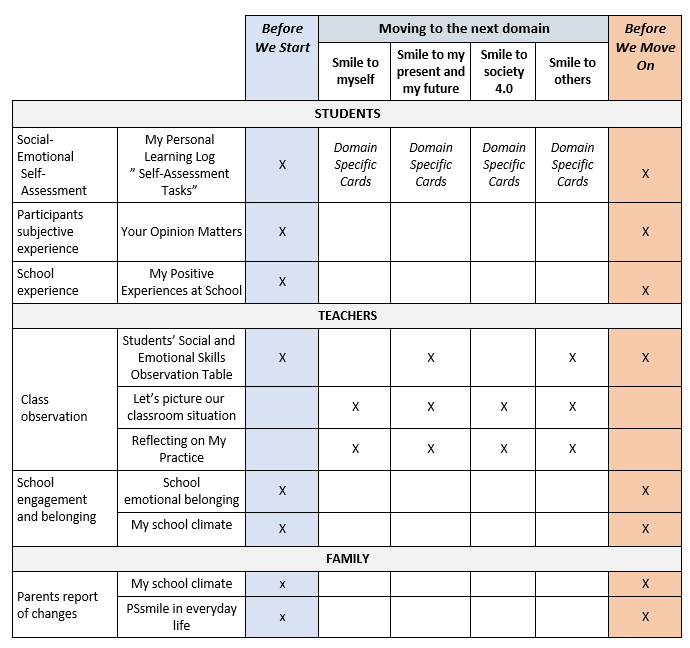
Before We Start Learning, assessment will involve both students, teachers, and family members. SES will be addressed together with individual strengths and in line with the projects the attitudes towards future and decision-making skills will be also measured.
For each activity A specific activity related focus will be adopted involving
students with active participation and reflective questions. teachers with quiz, reflective questions, take home activity. family supporting home activities with their children.
Before we move to the next domain Self-evaluation notes will be proposed to teachers asking them to reflect on their implemented activities and adjust their new plans accordingly. Students will be involved answering to questions from a qualitative tool focused on future (A message for my future; The compass of the future, The magic lantern).
Before we move on. At the end of the curriculum learning assessment will again involve both students, teachers, and family members. SE Skills will be addressed as in the Before We Start Phase
Assessment in the preliminary phases of the project and at the end of the curriculum aims to describe the starting level of knowledge and experience and provide general feedback about the level of student achievement with reference to the defined curriculum standards and specific assessment criteria. Intermediate assessment and monitoring will help tracking their own progress, receive feedback on their progress. This will also help teachers monitor the progresses in learning and eventually adjust it to improve learning and stimulate student progress.
2. Self-Assessment for Students
The tools proposed are meant for students’ self-assessment and are recommended to be used on a regular basis. Student self-assessment cards will help students monitor and assess their individual learning progress in developing their social and emotional skills
 “My
Personal Learning Log” Self-Assessment Tasks (from the Learning to Be project)
“My
Personal Learning Log” Self-Assessment Tasks (from the Learning to Be project)
The Modified version of this self-assessment tool for primary school children drawn from the Learning to Be project is a less formal set of task sheets that children are asked to complete.
The questions and tasks included in both instruments are based on the 3 main SEL goals:
o Develop self-awareness and self-management skills to achieve school and life success
o Use social awareness and interpersonal skills to establish and maintain positive relationships.
o Demonstrate decision making skills and responsible behaviors in personal, school and community contexts
o Use current experience to orient themselves toward future and building inclusive and sustainable future self and communities
The tasks are structured according to the educational objectives described in the SEL standards for learners 9–10-year-olds
These self-assessment cards are designed not only to encourage the students to assess their learning individually, but also to support the teachers in implementing strategies of formative assessment.
Each student receives a new assessment card at the beginning of the domain
Students are asked to fill-in their assessment cards. This could be done at the end of a lesson or during a special class meeting during the week
At the end of each domain, the responsible class teacher collects all his/her students’ assessment cards and writes feedback comments in the dedicated sections. After this, the teacher returns these sheets together with feedback notes back to the students.
At the end of the program, the students are asked to review all their sheets and identify their main areas of progress and major needs for future learning.
The future we want
This
tool adapted from Saigh (1997) examines
the individual's orientation towards his/her future. It consists of 8 items
reflecting:
Future Interpersonal relationships, such as: “In the future I will have friends,”¸
Expectations for the future, such as: “I like to make plans for things I like to do.”
The participant is asked to rate the extent to which he/she agrees with each item on a 5-point Likert-type scale, ranging from 1 (strongly disagree) to 5 (strongly agree).
My
Positive Experiences at School
The Positive Experiences at School Scale (PEASS; Furlong, You, Renshaw, O’Malley & Rebelez; 2013) is a brief, self-report, developmentally appropriate assessment with subscales measuring four school-anchored positive-psychological traits that are linked with youth well-being and school engagement: gratitude, zest, optimism, persistence, and prosocial behavior. The composite score of the four PEASS subscales was hypothesized to represent student covitality.
The survey questions are proposed that ask students, like them, about what they think, feel, and do at school. hey, are asked to read each sentence and choose the response that tells how true the sentence is for them Teachers will ensure anonymity and confidentiality of the student responses. Teachers are also encouraged to present the findings to the class and discuss how could make the activities more effective.
Your
Opinion Matters
The survey, drawn from the Learning to Be project, is used to ask students about their feelings in class; active involvement; motivation; expectations from the teacher.
Children are asked to read the questions and express the level of agreement they experience.
3. Teachers
 Two levels of analysis are considered pin the learning assessment
that involves teachers:
Two levels of analysis are considered pin the learning assessment
that involves teachers:
o Classroom level Assessment instruments and simple practices are used by teachers to assess the students’ performance and changes in behavior and attitudes.
o Teacher level Tools are for self-assessment of their teaching practices as well as personal behavior and attitudes. The tools aim to help teachers reflect on their teaching and encourage professional development.
 Class observation tool for teachers (from the Learning to Be
project)
Class observation tool for teachers (from the Learning to Be
project)
This tool was designed for teachers to be able to observe and assess each student in the classroom. This Tool is based on the five SEL Core Competencies and the main goals for social and emotional learning
The class observation sheet consists of 3 parts:
1) Students’ Social and Emotional Skills Observation Table. This table includes a list of SEL categories to be observed in the students’ behaviour during the lesson. Once a week the teacher is asked to make short notes for each student according to the different SEL categories
2) Let’s picture our classroom situation In this table, the teacher marks specific experiences or situations in which the students may be involved during the week and which affect the student’s behaviour (e.g., negative experiences/situations: conflicts, bullying, disruptive behaviour; or positive experiences/situations: high student engagement, celebrations, class successes). Observing such experiences/situations will help the teacher to become better aware of what is happening in class and plan how to respond to these situations.
3) Reflection on my practice This part is meant for the teacher to evaluate his/her teaching practices and their impact on the students, with the aim of developing professional competences related to a specific domain
School engagement: Psychological Sense of School
Membership
The students’ emotional engagement as indicated by their feelings about their school and about their relationships with teachers and peers was measured using items from the Psychological Sense of School Membership (PSSM; Goodenow, 1993; You, Ritchey, Furlong, Shochet, and Boman, 2011) tapping Caring relationships and Acceptance.
The items are scored on a four-point scale from strongly disagree (1) to strongly agree (4) and then summed to form a total score.
My school climate
My school climate points out the strengths of the school and brings attention to the challenges that need to be addressed. The items are scored on a four-point scale from strongly disagree (1) to strongly agree (4) and then summed to form a total score.
4. Family
 At the beginning and at the end of the program implementation, a family member is expected to be involved.
 PSsmile in everyday life
A strength-focused competency-based framework consistent with the five CASEL competency domains is used, consistent with choices and content addressed in the Pssmile curriculum activities. The social-emotional skills represent the five competencies: Self-Awareness, Self-Management, Social Awareness, Relationship Skills and Responsible Decision Making. It also includes a section devoted to future.
 My school climate for parents
My school climate for parents points out the strengths of the school their children attend and brings their attention to the challenges that need to be addressed. The items are scored on a four-point scale from strongly disagree (1) to strongly agree (4) and then summed to form a total score.
5. Learning assessment summary Table