PSsmile - Curriculum Framework
| Site: | PSsmile E-learning Course |
| Course: | Part 2. Curriculum Framework |
| Book: | PSsmile - Curriculum Framework |
| Printed by: | Guest user |
| Date: | Tuesday, 25 August 2026, 8:23 AM |
Table of contents
- 1. Defining The Domains With Our Lenses
- 2. The Innovative Focus
- 3. {mlang en}Self-Awareness{mlang} {mlang it}insert text here{mlang} {mlang lt}insert text here{mlang} {mlang pt}insert text here{mlang} {mlang el}insert text here{mlang} {mlang bg}insert text here{mlang}
- 4. Self-management
- 5. Social Awareness
- 6. Relationship Skills
- 7. Implementation Principles
1. Defining The Domains With Our Lenses
The curriculum goals have been developed considering main suggestions coming from international research studies and theoretical approaches both in contents and in methods adopted. Figure 1 provides a summary visual representation of the domains considered. In more details, for each domain we can identify the focus in the activities:
AWARENESS -SELF : SMILE TO MYSELF
Goals of Didactical activities: to promote knowledge of characteristics and strengths of each child as physical aspects, preferences, interests, dreams, hope, optimism, courage that are included in a positive mindset and the role they play in people life.
Focus: Exploring and developing multiple ideas and perception of multidimensional (social and emotional) components of Selves and focusing on possible consequences and paths for self-development as well as contextual resources as parents, teachers, friends.
MANAGEMENT -SELF: SMILE TO MY PRESENT AND MY FUTURE
Goals of Didactical activities: to promote the development of social and emotional strategies each child could use to presents himself/herself and to describe positive aspects to others.
Focus: learning of strategies on how to find new ways of thinking and feeling about themselves; planning strategies for achieving goals and decision making that improve personal growing and capabilities.
AWARENESS -SOCIETY: SMILE TO SOCIETY 4.0
Goal of Didactical activities: to promote a higher knowledge of both social and emotional aspects in current contexts and environments children attend to and that could be relevant in their adult life.
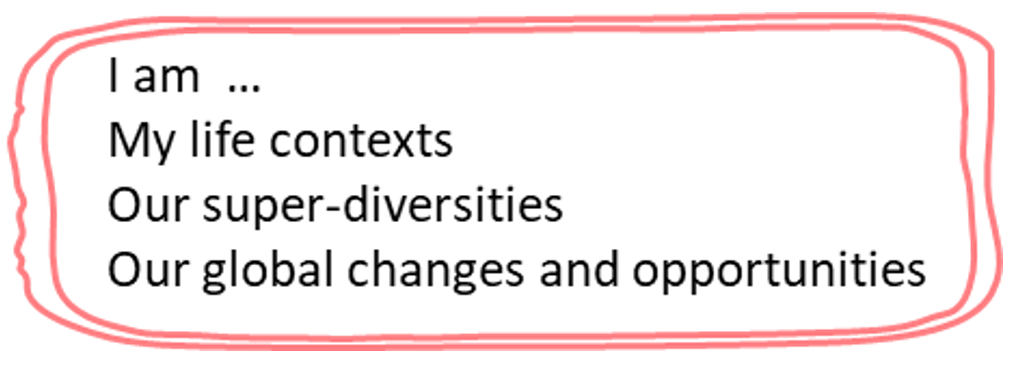
Focus: knowing multiple aspects, both emotional and cognitive, that contribute to define people in the context and environments and how all this influence thinking and feelings; identifying changes and opportunities that our global times consider as relevant to become citizen of the world.
MANAGEMENT OTHERS : SMILE TO OTHERSGoal of Didactical activities: to develop social and emotional skills to promote positive relations with others in multiple contexts to actively participate in current and future inclusive communities; developing knowledge on sustainable goals.
Focus: exploring and developing reciprocity of ways of thinking, feeling, and interacting, finding productive strategies to be in and to actively contributing growing of diverse contexts.
The PSsmile choice
As shown in the visual representation, both the emotional and the social component are considered in each domain. Decision making and time perspective are proposed as overarching components, involved both in the development of awareness as well as in management of everyday life situation, both for Self and Others domain.
2. The Innovative Focus
It is well-known that the complexities of current times represent threats to well-being and participation and requires the assumption and integration of multiple visions, as well as the involvement of people in life contexts (Fernandez, 2020). In the curricula and activities developed the attention is still strongly oriented to the management of current life while a limited attention is given to future, to direct SE capacities towards the construction of future, to face the challenges that children will almost certainly encounter.
A specific attention is given in all the activities proposed across the four domains on introducing activities where a time perspective view, more specifically a future oriented time perspective, is adopted guiding the decision-making process.
 Time perspective (TP) refers to the way each person perceives and interprets experience, according to different time frames(Zimbardo & Boyd, 1999), and a sense of continuity between the time frames: past, present, and future (Savickas, 1997).
As regards Future Time Perspective (FTP), definitions in the literature describe it as the ability to imagine one’s future, the anticipation of future goals, including learning and
academic achievements (Peetsma, 2000; Peetsma, & van der Veen, 2011).
Future Time Perspective encompasses personal cognitions, feelings, and behavioural intentions with respect to the future: cognitions refer to thoughts about future outcomes and goals that are valued; feelings correspond to the emotions (e.g., hope and fear) that are associated with the future; finally, behavioural intentions relate to individual’s plans to engage in behaviours to realize future goals.
Future Time Perspective and School Life. Higher Future Time Orientation is associated with various behaviours that promote success in school, such as dedication and commitment to academic tasks; delay of gratification or resistance to distraction and use of self-regulation strategies (Bembenutty & Karabenick, 2004; de Bilde, Vansteenkiste, & Lens, 2011; Eccles & Wigfield, 2002; Gutierrez-Braojos et al., 2014; Peetsma, Hascher, & van der Veen, 2005; Peetsma & van der Veen, 2011; Simons, Vansteenkiste, Lens, &
Lacante, 2004).
Future Time Perspective and Decision Making. The ability to think about the future has been associated with many health behaviours, whereas to be blind to the future has been considered a predictor of a variety of maladaptive behaviours (Chen & Vazsonyi, 2011; Joireman et al., 2012). Having a prospective mindset and future orientation, seems to support the development of a safe decision-making, from the early ages and during adolescence (Daniel et al., 2013; Cheng, et al., 2012; Lin & Epstein, 2014). Moreover, FTP is central not only for education and health: in the domain of work, researchers have linked FTP to effective career decision making and planning, and to career-choice satisfaction.
The PSsmile choice
By orienting to the future and establishing specific goals in different life domains, by anticipating attitudes and behaviour to undertake in future situations, individuals of different ages develop motivation and decision-making skills and are driven to achieve those goals.
Being oriented to the future is therefore a fundamental concept to consider in educational context for supporting the way children build their lives, especially in complex times such as the ones we are currently living and those that future adolescents and adults will navigate throughBeing oriented to the future is therefore a fundamental concept to consider in educational context for supporting the way children build their lives, especially in complex times such as the ones we are currently living and those that future adolescents and adults will navigate through.
3. {mlang en}Self-Awareness{mlang} {mlang it}insert text here{mlang} {mlang lt}insert text here{mlang} {mlang pt}insert text here{mlang} {mlang el}insert text here{mlang} {mlang bg}insert text here{mlang}


 General goals
Develop knowledge and awareness about strengths (feelings, emotions, personal resources) that promote taking care of positive future selves.
Focus on possible consequences and paths, as well as contextual resources, for development of Self
Know and explore the nature of emotions and feelings and how they characterize myself in my daily life situations (at school, at home etc.):
- know what emotions and feelings are (i.e., be able to describe their characteristics, differentiate them) and recognize my emotions and feeling (i.e., naming them)
- know emotions and feelings impact reasoning and behaviors, explore my emotions and feelings and how I express them (i.e., describe what I feel, how I behave)
- know what generates emotions and feelings from a biological perspective and recognize what happens to me (i.e., adrenalin, fear, tremble)
- know my thoughts and my behaviors impact my emotions and feelings and explore how they influence my emotions and feelings (i.e., when I have negative thoughts, I experience negative emotions)
- discover my uniqueness in interpreting and expressing emotions and feelings (i.e., each person is unique and has specific way of interpreting them) as components of my positive mindset
Explore and understand my positive personal resources
- know what personal positive resources (i.e., optimism, hope, resilience, time perspective) are and recognize my personal resources (i.e., describe their characteristics, differentiate them, name them)
- know that personal positive resources impact reasoning and behaviors, explore my personal positive resources, what happen to me and how I express them (i.e., describe my optimism, what happens to me biologically, how I behave)
- discover my uniqueness in interpreting and expressing my personal positive resources as components of my positive mindset (i.e., describe them)
Discover that the positive mindset plays a role in my flourishing:
- know components of positive mindset (emotions, feelings, and personal resources) that characterize the concept of Me (i.e., a picture of me)
- recognize that a positive mindset reflects my strengths and resources I can count on in my daily life situations (i.e., a picture of my strengths in diverse situations, what I use and not use)
- identify components of a positive mindset that impact the development of my strengths (i.e., positive emotions and feelings contribute to developing my interests, my likes, and dislikes).
Progress in exploring my possible future Selves
- know a positive mindset plays a role in opening my mind and developing my possible future selves (i.e., optimism helps in finding new opportunities)
- identify components of a positive mindset I should take care of to build my future selves
4. Self-management

 General
goals
General
goals
Promote knowledge on ways to manage emotions and feelings each child could experience; Learn and use strategies on how to find new ways of thinking and feeling about themselves; Plan decision making and actions to achieve goals that improve personal capabilities and Self development.
Explore how to manage emotions and feelings
- Know the importance of regulating emotions and strategies for managing them
- Identify and explore ways to manage my emotions and feelings in my daily life situations (what I can do when I am sad, happy etc.)
- Practice and reflect on strategies to react positively to my challenging emotions in my daily life situations
Discover and practice ways to foster my positive resources
- Know the importance of taking care of my positive resources
- Identify and practice strategies for fostering my positive resources in challenging situations and failure (i.e., asking for help, take time to think)
- Reflect on and evaluate strategies useful in fostering my positive resources
Explore and understand how to take care of my personal strengths (i.e., at school, at home etc.):
- Identify what are the strengths (interest, likes) I wish to foster and cultivate, and explore the benefits
- Explore and practice strategies to take care of my strengths and cope with possible challenges (i.e., short term goals, school transitions, etc.)
- Reflect and evaluate on strategies and practice in taking care of my strengths
Progress in building possible future Selves
- Explore the concepts of change and growth as part of life and foresee my possible future selves
- Discover that change and growth can impact negatively and positively my goals achievement and happiness (i.e., worries, stress, excitement) and explore ways for managing them (i.e., coping)
- Learn how to set my personal and educational goals and monitor progress on achieving short-term personal goals and possible selves
- Identify resources and supports I could count on to strengthen my future goals
5. Social Awareness

 General goals
Promote a higher knowledge of social and emotional aspects and personal resources in contexts and environments children attend to;
Identify changes and opportunities occurring in small and large communities and focus on personal contribution to construct a positive community.
Explore the nature of emotions and feelings as positive mindset in people I know in my life context
- identify my life contexts and people with whom I spend my time (people I meet, request they do, what we do together etc.),
- identify attitudes and emotions people I know might experience in our life contexts,
- recognize that each of us feels and respond in different ways,
- understand how emotions are influenced by personal behavior and by others behavior
Explore and understand personal resources as positive social mindset in my life context
o know positive resources relevant in the relationship with others (i.e., curiosity, empathy, solidarity, flexibility, etc..), describe and differentiate them
o know how personal positive resources impact reasoning and behaviors (i.e. analyze positive and negative stories)
o explore cultural diversities in expressing emotions, feelings, and positive mindset in social contexts
o recognize and appreciate that each person has multiple identities and uniqueness
Discover changes and challenges occurring in small and large communities and understand the impact of positive mindset
- recognize changes occurring in small and large communities, emotions, and feelings they may activate in persons experiencing diversities (social inequalities, climate changes, unexpected health issues)
- identify the potential challenges and opportunity hidden in these changes to positive mindset and relationships (i.e., discover unexpected skills),
- identify and acknowledge that my behavior can change the people mindset (i.e., how people feel) and contribute to the wellbeing of people living in my community.
Progress in exploring positive
future communities.
- understand and acknowledge the value of diversities and the hidden opportunities in cultural diversity for enriching ourselves and grow
- discover and reflect on situations in which people using their positive mindset transformed a challenge into an opportunity
- identify different lenses to look at possible future challenges in my community
- identify possible resources and supports, as well as persons, I could count on to reach these goals.
6. Relationship Skills


 General goals
Promote positive relations with others and pro-social behaviors in diverse life contexts
Find and practice strategies effective in supporting growth and development in diverse contexts; Plan decisions and actions to achieve goals that promote active participation in current and future positive communities
Explore and understand positive relationships with others in diverse situations
- Recognize and value positive relationships and the personal needs they fulfill,
- Identify emotions and feelings that contribute to a positive climate in group activities
- examine and practice behaviors that promote a friendly and cooperative climate in group activities (i.e., in the classroom, at home in other life contexts)
- Identify challenges to positive relationships in everyday life contexts
Know pro-social behaviors and explore ways to work with others
- Explore ways to react positively in challenging interpersonal situations in the classroom, at home and in other life contexts
- Explore positive mindset strategies to adopt in challenging situations
- Know what prosocial behaviours are and practice them in real life situations
- Acknowledge the role of positive mindset in pro-social behaviors
Explore and understand how to take care of my social strengths (i.e., at school, at home etc.):
- Identify what are the pro-social behaviors I wish to foster and cultivate, and explore the gain now and in the future (i.e., what you do today impact your future)
- Explore strategies useful to take care of my prosocial skills and cope with possible challenges (i.e., short term goals, school transitions, etc.)
- Learn how to use pro-social behaviors in my everyday life
- Share and practice effective strategies with my peers to learn from each other
Progress in building future positive communities
- Explore common goals and their characteristics
- Identify how common goals impact me and my future as a community member and foresee their value
- Learn how to set and contribute to common goals and monitor progress on achieving them
- Recognize resources and supports, as well as persons, I could count on to reach these goals and plan actions to strengthen them in the future
7. Implementation Principles
The analysis carried out by the partners underlined the relevance of making some choices at different levels in developing both the activities, the methodological materials, and the innovative resources.
 Procedural choices:
o Focus on both Social as well as on Emotional skills with a similar emphasis
o Focus not only on awareness development but also on management on everyday life situations in school and other life contexts
o Devote a specific attention to diversities, vulnerabilities and learning difficulties
o Use a language in line with recent theoretical approaches and enhancing strengths and uniqueness
o Adopt an ecologically relevant approach together with innovative methodologies, with attention to their flexible and personalized use
o Devote space to development of SE skills in teachers and parents
o Train the trainers to make teachers involvement more effective
o Consider resources already developed and in line with the choices of the PSsmile project
Theoretical and methodological choices:
o Assuming person centered approach. This means that in the reflection processes activated with the activities proposed we will focus first on people (me, the others) than on skills in themselves and on the agentic role that a person (child or adult) can undertake in their life contexts.
o Adopting a double lenses approach. This means that as suggested by recent approaches we will devote our attention to a positive development of the individual and at the same time to a positive and sustainable community development (Flanagan & Levine, 2010; Hart et al., 2014).
a. Orientation towards current and future life. This means that we will orient the activities proposed toward both current everyday lives, as well as to medium and long-term future time intervals (personal, work, and social future goals).
b. A self-community binary. This means that we will consider that an informed and engaged citizen is vital to both the individual positive development and wellbeing as well as to the health of societies.