1.2 From Emotions and Feelings to Socio-emotional Skills
| Site: | PSsmile E-learning Course |
| Course: | Part 1. Theoretical and Methodological Background |
| Book: | 1.2 From Emotions and Feelings to Socio-emotional Skills |
| Printed by: | Guest user |
| Date: | Tuesday, 25 August 2026, 8:23 AM |
1. Introduction
Emotions have a fundamental role at the evolutionary level, they serve to protect us, to recognize dangers and to defend us from them. It is necessary for the teacher and parent to build some basic knowledge on emotions and feelings in the first place. This basic understanding is necessary to be able to communicate and understand children in a better way, to understand what triggers their responses to external and internal stimuli and to be able to support them and guide them in a better way in the process of understanding and managing their own reactions and social interactions with other people around them.
2. The Roots
 We can refer to emotion
as a multi-componential term, including subjective feeling, appraisals,
reactions in the service of action preparation and expressions, action
tendencies, and regulation (Scherer, 2005; Frijda,
2007). For example, an appraisal of unfairness will result in
anger, whereas appraisals of outcome uncertainty and outcome motive
inconsistency will combine to produce a feeling of fear (Elfenbein &
MacCann, 2017).
We can refer to emotion
as a multi-componential term, including subjective feeling, appraisals,
reactions in the service of action preparation and expressions, action
tendencies, and regulation (Scherer, 2005; Frijda,
2007). For example, an appraisal of unfairness will result in
anger, whereas appraisals of outcome uncertainty and outcome motive
inconsistency will combine to produce a feeling of fear (Elfenbein &
MacCann, 2017).
Although emotions and feelings are quite different, these terms are usually used interchangeably to explain how something, or someone makes us feel. However, it is better to think of emotions and feelings as closely related, but distinct instances – basically, they are two sides of the same coin.
When talking about emotions we must also consider their physiological side, the lower-level responses occurring in the subcortical regions of the brain (for example, the amygdala, which is part of the limbic system) (LaBar & Cabeza, 2006) and the neocortex (ventromedial prefrontal cortices, which deal with conscious thoughts, reasoning, and decision making) (Bechara, Damasio, & Damasio, 2000; Donoso, Collins, & Koechlin, 2014). Those responses create biochemical and electrical reactions in the body that alter its physical state. Emotions are physical and instinctive, instantly prompting bodily reactions to threat, reward, and everything in between. The bodily reactions can be measured objectively by physiological measurement and neuroimaging technology, the most common are pupil dilation, skin conductance, skin temperature, blood pressure, vasomotor, brain activity, and heart rate, and facial expressions.
While emotions are associated with body reactions that are activated through neurotransmitters and hormones, feelings are the conscious experience of emotional reactions. Originating in the neocortical regions of the brain, feelings are sparked by emotions and shaped by personal experiences, beliefs, memories, and thoughts that are linked to that particular emotion. Strictly speaking, a feeling is the side product of the brain perceiving an emotion and assigning a certain meaning to it (LeDoux, 2012).
3. A Model of Emotions and Feelings
 One of the first and most prominent researchers is Paul Ekman
(2011) who has long
supported the view that emotions are discrete, measurable, and physiologically
distinct.
One of the first and most prominent researchers is Paul Ekman
(2011) who has long
supported the view that emotions are discrete, measurable, and physiologically
distinct.
For many years Ekman, in his research on facial expression, examined six emotions he theorized to be universally recognized: anger, disgust, fear, happiness, sadness and surprise (Shiota & Michelle, 2016). His latest research and recent cross-cultural studies have expanded universal emotions and provided evidence for other 22 emotions: amusement, awe, contentment, desire, embarrassment, pain, relief, and sympathy in both facial and vocal expressions, boredom, confusion, interest, pride, and shame facial expressions, as well as contempt, interest, relief, and triumph vocal expressions (Cordaro, Sun, Keltner, Kamble, Huddar, McNeil, 2018).
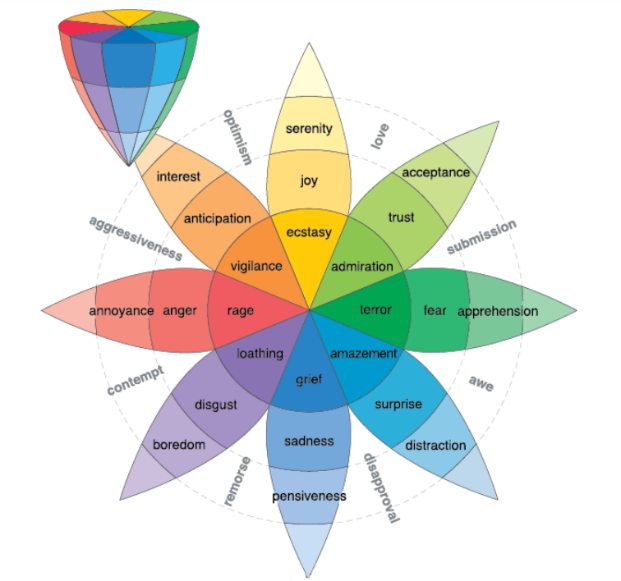
Figure 1. Wheel of emotion, Plutchik (2001)
Robert Plutchik, starting from Ekman's theory, developed the "wheel of emotions" (Figure 1), suggesting eight primary emotions grouped on a positive or negative basis: joy versus sadness; anger versus fear; trust versus disgust; and surprise versus anticipation (Plutchick, 2001). According to the author, basic emotions can change to form emotions, based on cultural conditioning or combined associations. Primary emotions could combine to form the entire spectrum of human emotional experience in a similar way to how primary colors combine. For example, anticipation and joy may combine to form Optimism, joy and trust may mix to form love, anger, and disgust to form contempt.
4. From Emotional Intelligence to Social and Emotional Skills
 Altogether emotions
are represented into the concept of Emotional Intelligence (EI).
Altogether emotions
are represented into the concept of Emotional Intelligence (EI).
It has been presented as a complex integrative concept and linked to personality traits that contribute to define the emotional intelligence itself. Furnam and Petrides’ model proposes 15 specific personality traits. With this concept some authors refer to a broad ability, equivalent to verbal or numerical ability except that the content domain is emotions rather than words or numbers (Mayer, Caruso, & Salovey, 2016).
Already in the nineties Salovey and Mayer’s (1990) expanded the concept of EI opening to motivation and a social component. They proposed a conceptualization of EI as “the ability to monitor one’s own and others’ feelings and emotions, to discriminate among them and to use this information to guide one’s thinking and actions”.
Later studies came up with an umbrella description of EI (Elfenbein & MacCann, 2017; Mayer et al., 2016) that includes:
- Perceive emotions: the ability to make judgments of another person's emotional state based on verbal and nonverbal expressions (e.g., tone of voice, facial expression, and posture)
- Express emotions: the ability to accurately convey or express an emotional state so that it is easily recognized by others
- Understand emotions: knowledge of how emotions progress over time, how they link to situational factors, and how they blend
- Regulate own emotions: the ability to regulate one's own emotions, up‐regulating positive emotions, and down‐regulating negative ones (and occasionally vice versa)
- Regulate others' emotions: the ability to regulate other people's emotions, up‐regulating positive emotions, and down‐regulating negative emotions (and occasionally vice versa)
- Regulate Emotion attention: the ability to regulate one's attention toward or away from emotional information
Within a real-life, practice-oriented, comprehensive framework based on research literature (Jones & Bailey, 2016; Jones & Bouffard, 2012), social and emotional skills are grouped into three conceptual categories:
o Emotional processes include emotional knowledge and expression, emotional and behavioral regulation, and empathy.
o Social/interpersonal skills include understanding social cues, interpreting others’ behaviors and perspective-taking, navigating social situations, interacting positively with peers and adults, and behaving in a prosocial manner.
o Cognitive regulation includes basic executive functions such as attention control, response inhibition, working memory, and cognitive flexibility or set shifting.
The authors apply a developmental lens to this topic and suggest that skills are salient at different developmental moments, with early skills laying the foundation for those that come later. These developments emphasize the role of both a behavioral and an interpersonal component within the context of one’s culture, neighborhood, and interpersonal situation where the interaction occurs (Elfenbein & MacCann, 2017), strengthening the link between the emotional and social component of human functioning and their development, and at the same time, orienting the attention to ‘skills’. And a broad definition of social and emotional skills describes them as ‘the kind of skills involved in achieving goals, working with others, and managing emotions’ (OECD, 2015).
5. ... and Social Emotional Competence
Social emotional competence refers to the ability to use social and emotional skills and knowledge to be resourceful, adapt to, respect, and work well with others, and take personal and collective responsibility. Furthermore, Social-Emotional competence involves an individual's ability to express, receive and manage emotions as well as their effectiveness in forming and maintaining relationships, and in general interactions.
Denham (2019) describes emotional competence into these core aspects:
o emotional expressiveness: refers to specific emotions shown, with varying purposefulness, by children (e.g., happiness, sadness, anger, fear, and empathy/love), and the overall rate of such expressiveness, across emotions
e.g., positive affect is important in the initiation and regulation of social exchanges; sharing positive affect may facilitate the formation of friendships, and render one more likable
o understanding of emotions: refers to children’s knowledge about the emotions of themselves and others, including comprehension of basic emotions, their expressions, situations, causes, and consequences; and discernment of display rule usage, mixed emotions, and more complex emotions (e.g., guilt and shame)
e.g., if a preschooler sees one peer bickering with another, and correctly deduces that the peer suddenly experiences sadness or fear rather than intensified anger, she may comfort her friend rather than retreat or enter the fray
o regulation of emotion and behavior: when its experience is too much or too little for themselves, or when its expression is too much or too little to fit with others’ expectations, by using physical, cognitive, and/or behavioral strategies to dampen or amplify internal emotional experience and/or external emotional expression.
e.g., play with peers is replete with conflict, this developmental focus demands emotion regulation; initiating, maintaining, and negotiating play, and earning acceptance, all require preschoolers to “keep the lid on”
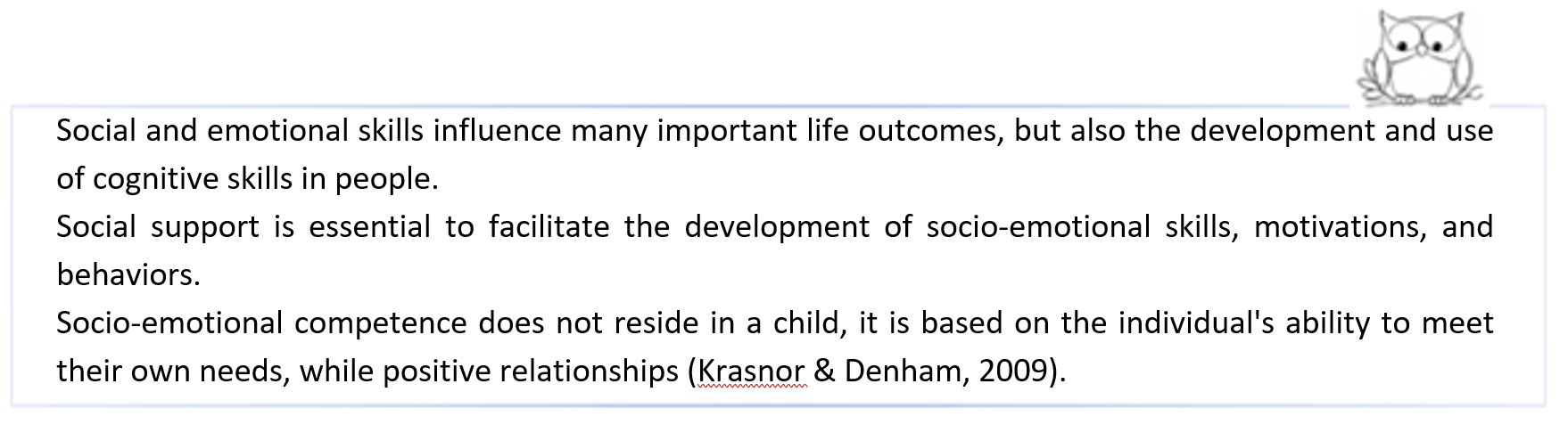
Since it is in the continuous interaction between individual and context that the child learns to regulate better their emotions and relate in a competent way (Denham, 2006), the mentioned emotional skills contribute to social competence (Denham, 1998; Saarni, 1999). Numerous research studies show that a relationship with a consistent, caring adult who actively promotes the development of these dimensions is essential for healthy social-emotional outcomes in young children. In general, positive emotion in the family is associated with children’s own positive emotions, with the converse true for negative emotion or lack of emotion (Denham, 2019). For example, family positive expressiveness also promotes emotion knowledge, perhaps because positive feelings render children more open to learning and problem solving (Denham, 2019).
6. Our Lenses
 The components of
social-emotional competence do not evolve naturally. The course of social-emotional
development—whether healthy or unhealthy—depends on the quality of
relationships that a child has the
possibility to experience.
The components of
social-emotional competence do not evolve naturally. The course of social-emotional
development—whether healthy or unhealthy—depends on the quality of
relationships that a child has the
possibility to experience.
Actively promoting social-emotional competence requires, then, choices and activities that:
 Adopt a perspective where both emotional and social are
considered
Adopt a perspective where both emotional and social are
considered
In the continuous interaction between individual and context it is mandatory to encourage and reinforce social skills such as greeting others, taking turns, cooperation and resolving conflicts. Devoting a specific space to emotions and behaviors, to knowledge and action level, to awareness and management skills, it means creating the bases for these levels to interact and allow children to experience more well-being and maintain satisfying relationships with others.
Care for the significant adults, both teachers and parents
Creating an environment where adult take care of their Social and Emotional Wellbeing and in which children feel safe to express their emotions with the contribution of teachers and family is essential for healthy social-emotional outcomes in young children.