{mlang en}The PSsmile app: The adults’ learning point{mlang} {mlang it}insert text here{mlang} {mlang lt}insert text here{mlang} {mlang pt}insert text here{mlang} {mlang el}insert text here{mlang} {mlang bg}insert text here{mlang}
2. The PSsmile app training and its content
The PSsmile Mobile App is an SEL guide structured to be a five-week-ling training program (Fig. 1). The training program follows the structure designed within the PSsmile project, which sees socio-emotional skills distributed between four domains (Self-awareness, Self-management, Social-awareness, and Social-management) and two overarching components (Decision making and Goal setting). Each week is dedicated to perfecting the skills of a specific domain, through the administration of daily exercises. In four weeks, learners develop skills related to the 4 domains of SEL, while in the fifth week they carry out exercises focused on improving their decision-making and planning skills. Users are asked to carry out their activities from Monday until Friday.
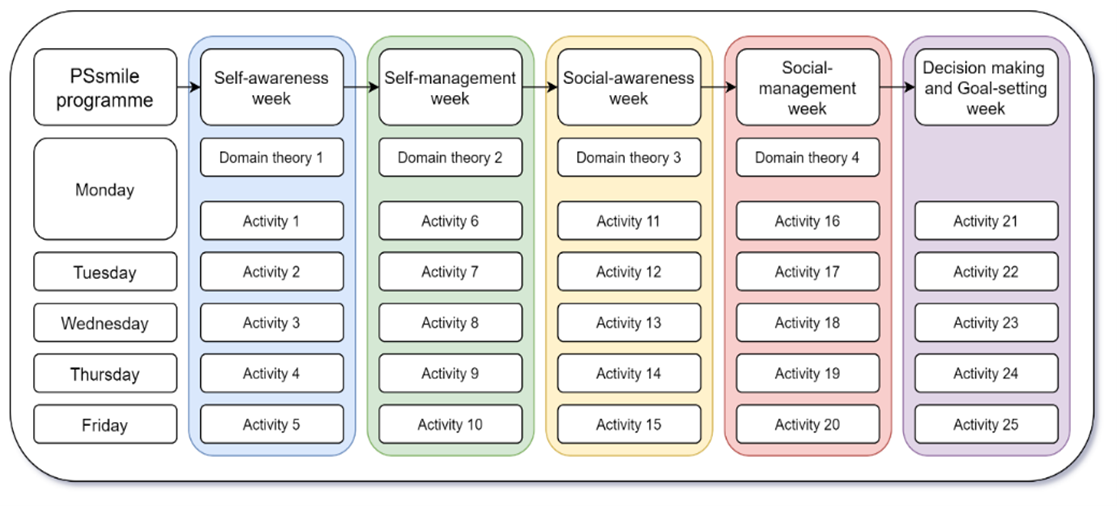
Fig. 1 PSsmile program structure
Not all the activities are immediately available to users, who are required to strictly follow the program structure. Once they start, every 24 hours the system unlocks the following activity. The program was designed in this way to promote incremental skills development and provide learners with enough time to reflect on what they have attained.
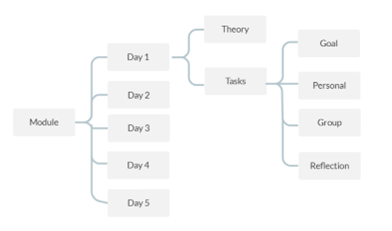
Each day is further divided into two sections: Theory and Tasks. The first provides an overview of the domain’s theme, illustrating the theoretical background of the activities and the skills that will be taught. The second section provides the activities of the day. The section “Tasks” is further divided into (Fig 2.):
Goal: the objective of the day’s topic and activities
Personal: an individual task assigned to the user
Group: a group activity that adults may carry out with pupils
Reflection: a self-assessment questionnaire, analyzing the successfulness of the activities and helping the learners reflect on them